To be held at Hanoi, Vietnam on 24-25 October 2026.Co-organized by VNU, University of Social Sciences and Humanity (USSH) and New Bulgarian University.Venue: Building E, University of Social Sciences and Humanity, 336 Nguyễn Trãi Street, Thanh Xuân, Hà Nội.
The rapid development of artificial intelligence (AI), particularly Large Language Models (LLMs) and generative AI systems, is profoundly reshaping how language, texts, and worlds are produced, interpreted, and experienced. In this context, literature, linguistics, and philosophy – fields centrally concerned with meaning, subjectivity, and understanding – are confronted with a new set of foundational theoretical and practical questions.
In literary studies and criticism, AI is no longer merely a technical tool but an active participant in processes of writing, interpretation, and circulation. This shift compels a re-examination of core concepts such as authorship, subjectivity, consciousness, originality, aesthetic paradigms, style, and genre. Issues of copyright, responsibility, human-machine co-authorship, and evaluative criteria are becoming increasingly urgent.
Within linguistics and philosophy, LLMs raise deep conceptual challenges concerning the nature of linguistic competence and understanding. A central question, in the spirit of analytic philosophy, is whether the linguistic behavior of LLMs can be legitimately mapped onto semantic states or whether it should instead be described as the outcome of statistical transformations over non-intentional symbol strings. These debates intersect with classic discussions of internalism and externalism in semantics, the role of agency, communicative intention, and context in meaning-making.
From a generative linguistic perspective, LLMs display a striking form of surface-level competence, producing highly acceptable linguistic sequences while simultaneously exhibiting systematic deviations from native-speaker grammatical intuitions. Such phenomena reopen questions about the relationship between E-language and I-language, and about whether emergent effects from large-scale training can be taken as evidence for abstract grammatical principles.
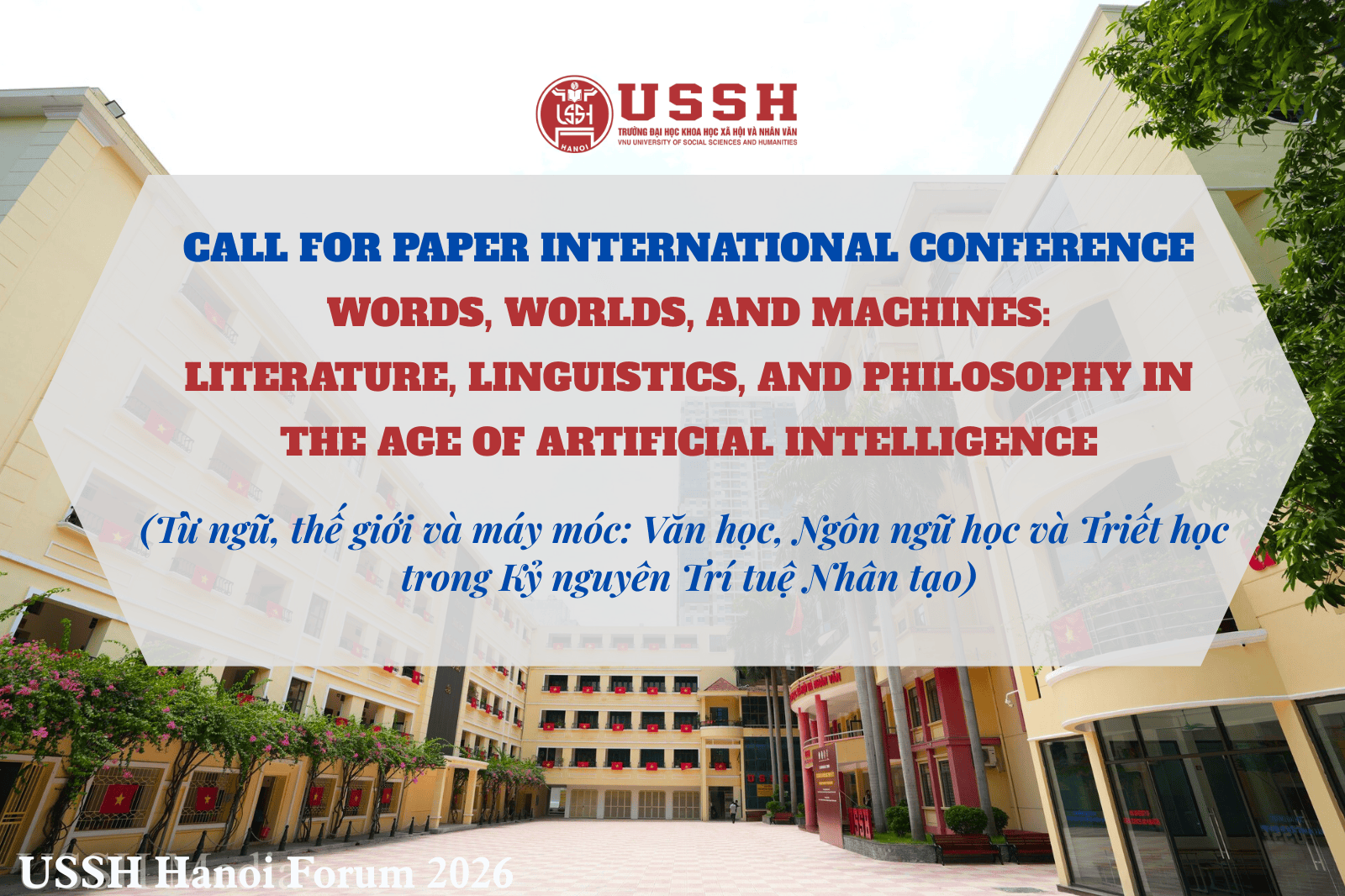
The international conference Words, Worlds, and Machines seeks to provide an interdisciplinary forum for scholars and graduate researchers to critically engage with these transformations, with a particular emphasis on meaning, authorship, interpretation, and understanding in AI-mediated cultural spaces.
We welcome contributions which pertain (but are not limited to) the following topics:
- Literature, aesthetics, and the humanities in the age of AI
- Meaning, interpretation, and understanding in LLMs
- LLMs and generative linguistics: competence, data, and emergence
- Philosophy of language, mind, and artificial intelligence
- Authorship, ethics, and scholarly practices
- Teaching, translating, and the future of the humanities with AI
1. Paper Submission Guidelines
- Abstract: The abstract should be 250-300 words in length. It should clearly state the research problem and central research question(s), the theoretical framework and/or methodological approach, and the expected scholarly contribution. The following information should be included: author’s name (and co-author(s), if any), institutional affiliation, contact email address, and keywords (3-5).
- Full paper: The full paper should be 6,000-9,000 words in length (including references) for publication in the conference proceedings, or alternatively, a paper summary of 2,000–3,000 words.
- Submissions must be original, unpublished work and must not be under consideration by, or submitted simultaneously to, other conferences or journals.
- Manuscripts must follow the APA style guidelines, including abstracts and references.
The conference welcomes theoretical contributions, critical analyses, empirical studies, case studies, and interdisciplinary approaches. High-quality papers will be considered for publication in open-access conference proceedings and may be recommended for special issues of national or international academic journals.
2. Schedule for Proposal and Paper Submission
- Abstract submission deadline: 15 April 2026
- Notification of review results: 15 May 2026
- Submission of full paper or paper summaries: 15 September 2026
- Confirmation of participation: 15 September 2026
- Conference languages: English and Vietnamese
- Submissions should be made via email to wwm.ussh@gmail.com
3. Conference Schedule
Plenary session of AUTUMN HUMANITIES FORUM 2026, University of Social Sciences and Humanities: 24 October 2026
International Conference Words, World, and Machines: 25 October 2026
4. Contact Information
Conference Organizing Committee:
University of Social Sciences and Humanities, Vietnam National University, Hanoi & New Bulgarian University
Website: https://ussh.vnu.edu.vn/eng/ ; https://nbu.bg/en
Email of the conference: wwm.ussh@gmail.com
Address: Building E, University of Social Sciences and Humanities, 336 Nguyen Trai Street, Thanh Xuan District, Hanoi